
Let’s be honest: Search Engine Optimisation isn’t magic. Understanding what SEO is helps to save you time and money and approach it from a position of knowledge. In this article, I’m going to help take the mystique out of SEO by explaining the basics.
What is SEO?
Put simply, Search Engine Optimisation is a process that aims to improve the organic search rankings of your website.
While SEO covers a range of activities, they fall broadly into three main categories.
1. On-page SEO
- Refers to the content on the pages of your website.
- Includes which keywords you are targeting.
- Includes how much and what type of content is on the page.
2. Off-page SEO
- Refers to ranking factors.
- Usually outside your direct control.
- Includes external websites that link back to your content.
3. Technical SEO
- Covers the coding and build of the website.
- Includes hosting and network speed.
- Majority of technical SEO is carried out by your web developer.
The detail: On-page SEO
On-page SEO consists of improving the text and images on each page, as Google uses these to rank the purpose and quality of a page.
Google also looks at all the pages on your domain to work out the main purpose of your website. It stands to reason, therefore, that any pages outside the main topic of your website are less likely to rank well.
It’s really important to know that any optimisation starts with On-page SEO and I cannot stress enough how important it is to get right. Without spending the big bucks on third party SEO work, On-page SEO and Technical SEO are the two areas where you can make relatively big gains for little outlay.
As the core principles of On-page SEO are easy to understand, once you’re used to implementing them, you’ll automatically write optimised content, which is more able to rank better in search queries.
Keywords
Remember that everything starts with the keywords (and synonyms) that are being used as search terms.
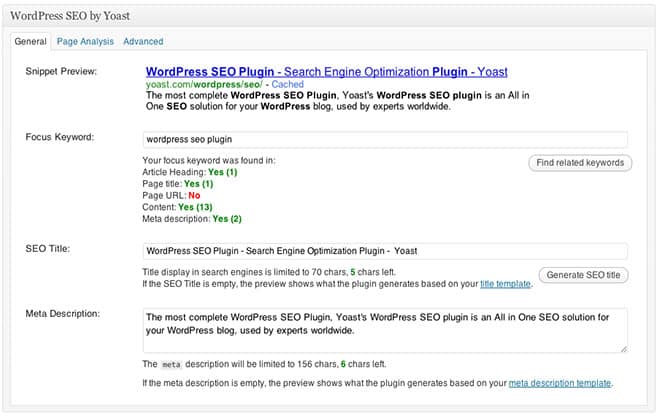
There are various ways of searching for the most relevant keywords. If your website is built on WordPress, the Yoast SEO plugin provides easy access to On-page SEO in the per-page settings, making the process of selecting and improving focus keywords much more effective:
Another option is with Google Keyword Planner (free, though you’ll need to sign in with your Google account) and a free tutorial.
After you’ve identified the primary focus keywords, you should also find a range of close synonyms. Each keyword should be considered for a greater chance to rank well for a range of search terms. You should also be aware of the penalty for overuse of your primary keyword.
Competition
After identifying the focus keywords you want your page to rank for, you should perform a Google search for them and check the top three results. You should aim to match the quality of these results with your page. Remember: Google wants to give people the best answer to their search query.
Titles, URLs, headings
Now that you’ve decided on your primary focus keywords and synonyms, put some thought into the structure of your page.
Use your primary keywords in the title, URL (Universal Resource Locator = the address of your page, usually beginning with http://) and main heading. After this, only use your primary keyword a couple of times in subheadings and main content, using synonyms elsewhere.
Main content
I cannot emphasise enough how important it is to use semantic HTML by breaking up your content into logical sections using paragraphs, headings, and subheadings. (Don’t fall for that old trick of simply making your headings bold text instead of actual HTML H1, H2, H3, H4, H5 or H6.) All lists should be either ordered (numbered) or unordered (bulleted).
This makes your content much easier for your readers to scan quickly to find what they looking for – and if it’s easy for the user, it’s easy for the search engine, so the page ranks better. Do ensure you use just a few instances of your primary keywords in the main body and headings, but you shouldn’t overdo it.
Incorporating synonyms of your primary keywords will also help your page rank for related search queries.
Remember: on average, the top three search results are usually over 2,000 words in length. That’s something to think about when planning pages, articles and posts.
Images
Images are usually forgotten by most people, who forget or simply don’t know how important it is to optimise your images for SEO. At the moment, Google can’t see what an image is (it only sees the filename and the ALT tag – another reason to always set a related ALT tag) and large, uncompressed images can increase page load times (i.e. slow down your website for the average user) and thereby affect your rankings.
Remember:
- Use relevant, descriptive words in the image filename.
- Use ALT text to describe the image.
- Optimise the image size and quality for the web (i.e. make sure the file isn’t too big).
The detail: Off-page SEO
Now that we’ve dealt with the low-hanging fruit, let’s move onto something most people who have a basic knowledge of SEO grasp quickly: external links help your website to rank.
Link building is the term used to describe the technique of getting other websites to link back to your site. Generally the more inbound links, the greater the chance of ranking for the target keywords. If it helps, you can think of each link as a like or vote for the site.
Links and mentions are the stock-in trade of the SEO agency and are primarily what you’re paying for.
Links
What is a link (also known as a backlink)? You’re already familiar with it, even if you don’t know it. It’s where one website inserts a hyperlink to another website (using the HTML A or anchor element). These links are (or should be) contextual, pointing from a third party page to one of your pages.
Links are vital to improving search rankings. However, some links are able to rank far better than others. A good SEO agency is able to canvas and prioritise potential target websites for creating backlinks.
How Google evaluates links
- Are the linking domain and article relevant to the link target?
- How strong are the linking domain and article?
- Is the link paid or editorially driven?
- Where is the link on the page?
- Does the link use a ‘nofollow’ HTML tag?
- How many links are there on the linking page?
- Is the article positive or negative?
- What is the link’s anchor text?
That’s quite a lot to work through, which is why you need specialist SEO knowledge and why the SEO agencies are paid the big bucks.
Mentions
Mentions are similar to links, save that there’s no actual link between the sites. Mentions are usually made in the form of a quote and citation; the citation consists of the name, role and organisation of the person being quoted.
As many powerful websites enforce an editorial policy not to link externally, Google gives credit to citations. (If it were unable to measure mentions, Google’s ranking algorithm would be highly suspect.)
Even though mentions don’t give you as much credit as links, don’t ignore them.
As with links, Google uses multiple factors to assess a mention, so it’s important to ensure your company or organisation brand and niche are clearly noted or else the Google algorithm may not give you the credit you deserve.
The detail: Technical SEO
Technical SEO covers the technical aspects of a website’s performance. Some of these will be obvious to the end user, some won’t.
Factors include:
- Website load speed
- Website page size
- The number of page calls and redirects
- The number of pages indexed in Google
- Sitemap(s)
- robots.txt file
- 404 pages
- 301 pages
- Navigation design
- URL structure
Technical SEO can quickly get rather complicated and really needs to be undertaken by a specialist – your web developer.
The best part about Technical SEO is that once a technical SEO audit has been carried out and any recommendations implemented, the technical aspects of SEO usually only need to be monitored. There shouldn’t really be any changes to your website performance unless significant changes are made to the underlying technology.
Summary
I hope this article has helped to lift the lid on SEO and introduce you to the basics, so you have a good grasp of the essentials and can relate easily to the terminology. You’ll be better equipped to have a conversation with your chosen SEO partner and better prepared to create your own content for your website.

Edward Solomon has over 30 years’ experience in project management, technical education, computer networking, web design and development and is a Digital Business Consultant for PENNInk Productions Ltd.