
The best digital marketing campaigns have a lasting impact on your business — and to have a lasting impact, they need to be closely allied with your business as a whole. In order for digital marketing to truly work for your organisation, you need to ensure that your entire business is thinking digitally, even when you’re actually offline. By integrating offline activities with digital marketing, you’ll be able to create campaigns that feel more real and authentic. At the same time, you’ll also be able to save money through budget consolidation, as well as achieve a deeper sense of achievement and audience engagement. Don’t make the mistake of dismissing online and offline synergy as ‘impossible’ — embrace the possibilities of both existing side-by-side.
Here is how to make the most of online when you’re offline (and vice versa).
Get company buy-in
One of the most crucial things that a company can do in order to maximise their digital success, is to ensure that every level of the organisation, right up to the senior management team, understands the importance of digital success. It’s imperative that all company resources and team members are made available to the digital team. Without full buy-in and a real commitment to spending company time and money, digital marketing efforts will be furtive at best.
- Using facts and figures, explain why digital marketing is so central to your brand’s future success.
- Show examples of existing online metrics to show what has already been achieved, but also pave the way for future growth.
- If senior management agree that digital is a priority, digital marketing questions will be brought to the forefront during team meetings.
- By putting digital on the company’s roadmap, a more sustainable strategy can be developed that combines offline and online concerns.
- It’s important to involve different teams and departments.
- Simply leaving digital entirely to the digital marketing team will lead to a one-sided online conversation.
- It’s much better to start talking in digital terms during team meetings, giving people an open platform to discuss how digital affects their work.
- By talking more openly about digital and its role, it will become a lot more exciting, and a lot more tangible, for staff and managers.
- An organisational understanding of digital is a supremely important asset.
Focus on long-term projects
People don’t often associate longevity with the ephemeral world of digital marketing, but digital initiatives can actually help improve long-term company initiatives and projects. It’s worth investing time into combining offline and online company projects — when it comes to ongoing business needs, digital can be your ally.
- Recruiting people and finding the right talent for your company can be improved with the help of digital.
- Digital marketing will succinctly communicate your brand values and your team culture to your network and beyond.
- Marketing your employee experience is one of the best ways to ensure that you will be hiring talented people, who understand your company culture before they even start!
- Your brand manifests itself in your logo, people, company literature, website, and your social media accounts.
- Digital marketing is a brand building tool that should be be used to bolster other branding and marketing activities. A new brochure or print campaign should be celebrated online with dedicated graphics and social media posts.
- Social media is a fantastic place to talk about long-term company projects and changes like refurbishments, moving office, substantial staffing changes, and any other important things that affect your company environment.
- A time-lapse video of a new office space, a heartfelt goodbye post to an office that has served you well, or a full-blown ‘meet the new team’ online video are just some of the examples of how social media can be used to tell people stories about your company.
- Don’t use social media as a narrow platform just for sales or content promotion; it’s a vital company communication tool that allows you to update your entire network instantaneously.
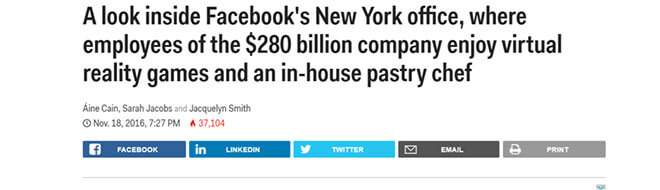
For big companies like Facebook, new offices generate a huge PR buzz, but you don’t have to be Facebook to make a big deal about moving offices. Connect it all up with an overarching story of your business, and reach out to local business and news sites.
Make the most of what you’ve got
A lot of companies make the mistake of feeling like they need to completely reinvent themselves online, constantly burning bridges and starting afresh. But in order to make the most of digital marketing, it’s important to re-use all the experience that you already have —; it will make your online brand a much more natural continuation of your physical one.
- Got a lot of paper content flying about? Migrate libraries, brochures, resources, and even surveys to more permanent digital homes.
- By making content freely available online, you will be doing yourself a massive SEO favour, but you’ll also save company space and time this way.
- While you are reviewing content, consider how to ensure that your company branding and designs remain as timeless as possible, so that you don’t have to keep endlessly updating assets.
- Think about how all the knowledge that you gathered over the years can be turned into new online formats.
- Comic strips, infographics, videos, blog series, webinars, whitepapers, calculators, and quizzes are just some of the available ones.
- Start to slowly transfer all your company knowledge and expertise into digital content.
- You can get digitally savvy teams to interview veteran experts and transcribe all their hard-won experiences for new audiences.
- Old nostalgia pieces also do really really well online.
- Consider opening up your company archives to a new online audience to help explain where you’ve come from, and the journey that you taken as a business.
Simplify customer support
Instead of your customer support team sending out the same instructions hundreds of times, or spending hours on the phone, create a FAQs webpage with screenshots and detailed instructions. Start using your website as a digital hub for your customer service operations, and it will quickly become a handy marketing tool as well.
Once you have a great customer support system set up (both offline and online), use this as customer value proposition. If you are known as a helpful company who always put their customer’s needs first, you will find it a lot easier to close sales. Especially if you are charging more for your products or services, a great customer service operation can help you justify that increased cost.
Improve data management
Digital marketing needs data in order to be successful, so make sure that all client data and acquired knowledge is successfully translated over into digital.
- Whether that’s through a full-blown CRM like Insightly, or even just a simple online address book, it’s imperative that you have accurate customer details so that you can personalise emails or send out more interesting news updates.
- When you go out to an exhibition and need to quickly capture a lot of personal information from people, consider whether using exhibition software or data capturing tools can help you automate the process (Akkroo is a popular app).
It’s so important to use data effectively in digital marketing, and having accurate customer data will help you bridge the gap between offline relationships and more digital relationships like email. Engaging digitally with people that your company already have a great standing with is one of the easiest and quickest ways to grow your network.
Maximise event coverage
Event marketing is a huge deal for loads of businesses, and exhibitions are still thriving in today’s world of online conferencing and Skype.
Offline business events attract a huge amount of attention on social media, and businesses can blow the competition out of the water by dominating event hashtags, covering the event like journalists, networking with people on social media, sending shoutouts to relevant guest speakers, or even identifying brands they’d like to work with through social interactions. By being present at an event, both online and offline, people will associate your name with quality coverage and visibility.
Invest in smart integrations for better customer experiences
Bridge the gap between offline and online by investing in smart business integrations.
Businesses need to strategically manage both offline and online data in order to serve customers better — they won’t care whether a purchase is made in-store or on mobile — they just want to buy something from you, whether that’s a product or services. Customers expect a seamless experience from your brand, so be more joined-up for a more coherent marketing strategy.
There are loads of plugins, tools, and applications that will allow digitals and non-digital environments to speak to each other — and integrations are getting smarter all the time thanks to AI. Using cloud software is a great way to manage an organisation that’s always in sync.
Running your business on the go is now easier than ever — ecommerce merchants can manage a point-of-sale system and an online store under the same ecommerce store subscription, or you can use smart elements that match up (like Shopkeep, the popular iPad POS). Being smarter about integrations makes total sense; it means you’ll be able to run better performing digital campaigns that run off completely up-to-date data. It also means that your customers will have a much more pleasurable experience dealing with you when they seamlessly travel between online and offline.
Don’t operate your business in silos — it’s an extremely dangerous way of doing things. Working in silos means not having a joined-up business strategy and potentially wasting valuable marketing budget. You are better off marrying offline with online in order to make the most out of both worlds. Digital marketing is nothing without the support of a robust offline team, and offline operations won’t grow without a proper digital investment!

Gareth is a technical SEO pro with over a decade in the industry. Now based in Bristol, his specialisms are blogger outreach and content. You’ll find him at his desk, drinking green tea and working on his latest campaign.