


I started using the World Wide Web around 1995. Back then, we used to think that downloading a 1MB file over a 14400 modem connection in about an hour was acceptable.
Today, however, speed matters. Most people simply don’t have the time or patience to wait for websites to load in anything more than a few seconds. Speed, power, and control. These should be the buzzwords for any company or brand that is serious about maximising mobile reach.
Search
Of course you and I both care about speed and Google also cares about speed. The theory for Google is and has always been that the faster the World Wide Web is, the more searches you’ll perform. The more searches you do, the more ads Google can show you. It’s a win-win scenario: the faster the Web works, the faster Google ads load and the more ads they can sell advertisers.
Make no mistake about it. Mobile speed is high on the list of priorities for Google. The Accelerated Mobile Pages Project (AMP) should be up and running by the end of this month (details in a recent article by Smashing Magazine). Late last year Google even partnered with content delivery network Akamai to help speed up enterprise applications around the world.
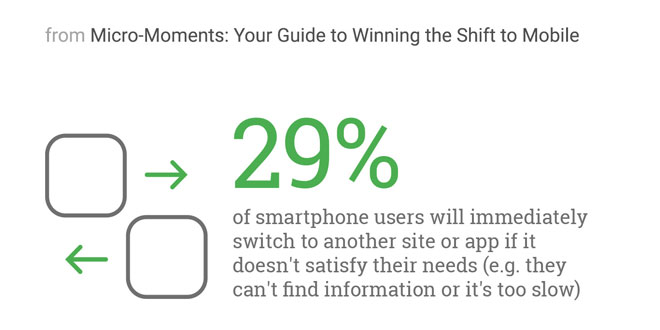
Here’s a statistic that should set alarm bells ringing for every website owner: according to Google, around 29% of smartphone users will instantly turn to another app or website if it doesn’t fulfil their needs in a few seconds.
Speed Is Key: Optimize Your Mobile Experience
Virgin America recently focused their mobile experience on one simple call to action: “book a flight.” They made room for a single call to action by steering away from offers or distractions that clutter the booking process. Today, their mobile customers can book a flight twice as fast.
Google says that 70% of those people switch because of slow site load times, while 67% will look for an alternative if there are too many steps needed to get the information they want.
You may not recall the Dark Ages of dial-up Internet access, when we thought a 28800 modem was quick and a 56000 modem blisteringly fast, but anyone that does will definitely share the pain of loading a slow website over a 3G connection. Google, citing a 2009 Forrester Consulting report, said that 40% of shoppers would wait 3 seconds for a travel or retail website to load. In truth, that’s an incredibly small window of opportunity and it speaks more about modern attitudes toward gratification than anything else.
Optimisation
Real world examples abound where reducing load time has resulted in high conversion rates. Google cites Walmart as an excellent example. Just two years ago in the autumn of 2014, visitors to the mobile site were greeted with a blank page for 7.2 seconds before seeing any content. Someone obviously did something about mobile performance optimisation because one year later, the page load time had dropped to 2.9 seconds. Now shaving 4 seconds off the page load time may not sound like much, but it can and does make a huge difference to conversion rates. According to State of the Union Page Speed & Performance (Radware, Spring 2015), for every second of improvement, Walmart.com experienced up to a 2% conversion rate increase.
You might reasonably assume that none of this comes as a surprise to us. Fast load time + relevant information = happy customer.
Fast load time + relevant information = happy customer. Share on XKey Questions
Today, consumers move faster than ever using smartphones and tablets on the go. Can your brand keep up? Start by asking these questions:
- What is the key action you want users to take on your mobile site or app?
- How long does it take to perform it? (Hint: if it’s more than a few minutes, it’s time to optimise.)
- Which functions on your website are absolutely essential for your mobile visitor?
- What do you already know about your visitors that can help you anticipate their needs?
- How long does it take for your site to load on a smartphone 3G connection? (Hint: engage your technical team to implement improvements.)

Edward Solomon has over 30 years’ experience in project management, technical education, computer networking, web design and development and is a Digital Business Consultant for PENNInk Productions Ltd.